-
 Marble Frieze Slab with Cult Scene at a Tree
R2 Cat. 149
Sculpture
Marble, Stone
3rd-4th C. AD (Roman)
The three reliefs which follow, two venatio compositions and an enigmatic cult scene, were found together, by chance, in a vegetable garden, ca. 145 m. W of PBr and ca. 130 m. E of the mausoleum of Claudia Antonia Sabina (No. 32.1 on Fig. 1; the find...
-
 Stele of Menandros Apol(l)oniou with Gorgoneion in Pediment and Inscription
R2 Cat. 150
Sculpture
Marble, Stone
3rd C. AD? (Roman)
The stele tapers markedly upward. It had a simple profile projecting over the l. and r. sides. A steep pediment (int. H. 0.20; int. W. 0.31) has a crude gorgon’s head. The bottom of the pediment is constituted by six horizontal flower calyxes, and in...
-
 Stele with Standing Draped Woman
R2 Cat. 151
Sculpture
Marble, Stone
Probably 3rd C. AD (Roman)
The relief is probably from a funerary stele. There is no indication whether there were more figures. The woman is standing, head turned to her r. with slightly bent r. arm across chest. Based on a Hellenistic type with short upper, long lower body, ...
-
 Top Fragment of Stele with Standing Woman
R2 Cat. 152
Sculpture
Marble, Stone
3rd C. AD? (Roman)
Steep triangular pediment has an incised line following edge of stele; base of triangle is a broken entablature. Within the triangle is an arch supported by impost blocks, which in turn rest on the base of the triangle, all with beveled sides. Within...
-
 Stele Fragment with Gladiator Relief
R2 Cat. 153
Sculpture
Marble, Stone
3rd C. AD? (Roman)
The gladiator, clutching a short sword in his r. hand, strides toward the r. He is enclosed by a rectangular cutting. Below his feet was an inscription, giving the man’s name; all that remains is ΚΟΣ. The gladiator wears a heavy helmet with squared t...
-
 Gladiator
R2 Cat. 154
Sculpture
Marble, Stone
3rd C. AD? (Roman)
The gladiator’s helmet has a protective flap covering his neck; the face is exposed. His round shield, covering the front and l. side of his body, has a small elongated knob in the front center, cf. Cat. 153 (Fig. 298). His body does not seem to be p...
-
 Five Gladiators
R2 Cat. 155
Sculpture
Marble, Stone
3rd or 4th C. AD (Roman)
A horizontal frieze shows five gladiators, fighting in pairs. Just above their heads is a projecting ledge, above which are traces of a second frieze. Each man wears a helmet with projections to protect the neck, and each has padded legs. The second ...
-
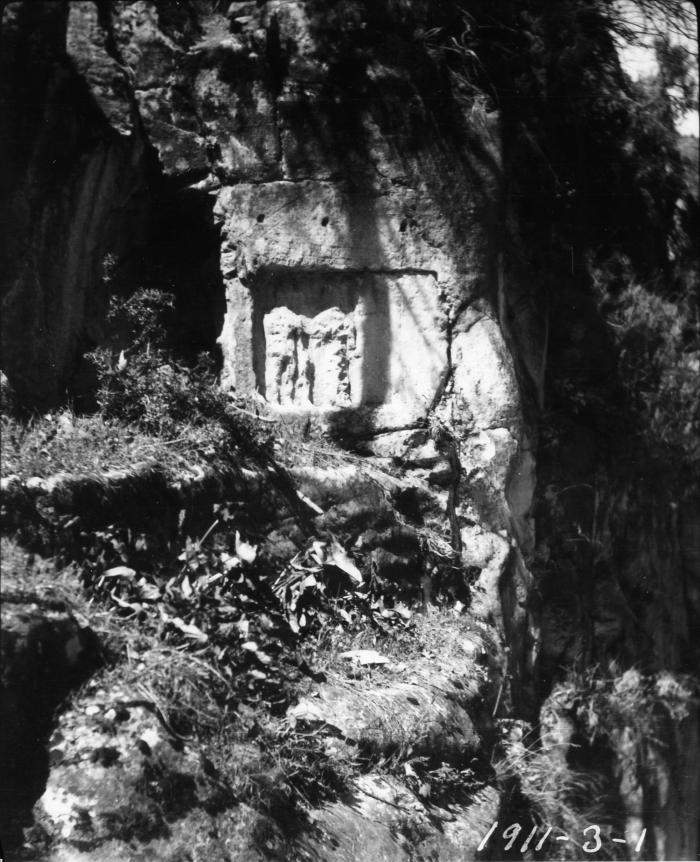 Rock-Cut Relief Aedicula with Two Frontal Figures
R2 Cat. 156
Sculpture
Marble, Stone
3rd-2nd C. BC (Hellenistic)
The architectural frame consists of a rather steeply pitched pediment outlined on the rock with rows of points. Underneath the pediment is a row of (originally 16?) rectangles alternately projecting and recessed; 8 raised and 4 recessed rectangles su...
-
 Fragment with Charioteer
R2 Cat. 157
Sculpture
Marble, Stone
3rd or 4th C. AD (Roman)
A Standing male figure is partially preserved; his l. arm, left part of his body, midriff, skirt, and part of the l. leg to just below the knee. This is a charioteer standing frontally, his l. arm lowered. He wears the typical chiton with multiple gi...
-
 Patera and Two Snakes
R2 Cat. 158
Sculpture
Marble, Stone
Early Hellenistic? (Hellenistic)
Two snakes face each other, with a patera between them. The patera, which is in much higher relief (0.04) than the snakes (0.004), is flat on the surface, then beveled out to the sides. There is a small hole in the center, depressed ca. 0.002 and 0.0...
-
 Cybele in Mural Crown in Front of Tree
R2 Cat. 159
Sculpture
Marble, Stone
150-50 BC? (Hellenistic)
At the top of the relief is a projecting simple profile. Below it are preserved the head of Cybele (or Tyche?) with a tall mural crown and the upper part of a tree. The head of the goddess is seen in profile, facing l. Her turreted crown sits on top ...
-
 Altar with Bucrania and Garlands
R2 Cat. 160
Sculpture
Marble, Stone
2nd C. AD? (Roman?)
The three bucrania of the cylindrical altar are tied to garlands with beaded ribbons vittae). Above the garlands are a moon, crescent, and star.
The dedicatory inscription mentions Noemon, priest of the Mother of the Gods.
The work is reasonably ca...
-
 Cylindrical Marble Altar with Eagle and Inscriptions
R2 Cat. 161
Sculpture
Marble, Stone
Late 1st or 2nd C. AD? (Roman)
The altar consists of a cylindrical shaft with apophyge (top and bottom), a crown molding and foot molding. The top consists of a convex ovolo surmounted by the beginning of a cyma. The raised central area of the top has a dowel hole, showing that an...
-
 Bringing Goat to Sacrifice
R2 Cat. 162
Sculpture
Marble, Stone
1st C. BC (Hellenistic)
At the l. is a goat standing on his hind legs toward the r., but with his head turned back over his shoulder; his forelegs are bent upwards and lean against the leg of a nude man or satyr walking or dancing toward the r. The male figure is preserved ...
-
 Horseman Riding Towards Altar
R2 Cat. 163
Sculpture
Marble, Stone
Late Hellenistic or early Empire (Roman)
A horseman with a flying cloak rides an elongated horse towards the r. The horse wears a saddle blanket, a belt which goes over his rump, a bridle, and two reins shown against his neck on one side. He has short incised curls for a mane. The man is sh...
-
 Dedicatory Relief and Inscription
R2 Cat. 164
Sculpture
Marble, Stone
3rd C. AD or later (Roman)
Three registers preserved on both fragments, each separated by a horizontal band. Top register: A, Attis holding a pine tree (?), and a frontal lion (fragment of mane preserved); B, Cybele seated on a throne (lower portion of drapery and r. side of t...
-
 Orans Figure
R2 Cat. 165
Sculpture
Marble, Stone
3rd or 4th C. AD? (Roman)
The relief is tapered slightly toward the top. A raised ridge ran along the top, arching gently out from the background. In the center is a figure in a long simple cloak with three vertical folds and elbow-length sleeves. His r. hand is raised, finge...
-
 Herakles (?) Incised on Block
R2 Cat. 166
Sculpture
Marble, Stone
(Roman)
In the center front of the block, 0.02 under the upper edge, is a shallow incised and chiseled figure of a standing nude male with a club (?) held in his r. hand and one end of it resting on the ground. He may have a lion skin over his l. arm, thus p...
-
 Fragment of Helios as Charioteer
R2 Cat. 167
Sculpture
Marble, Stone
5th or 6th C. AD (Late Lydian (Persian))
Helios is shown as a charioteer, swinging his whip over his head with his r. hand. The whip has a short handle and a long corded or braided strap which comes down to the charioteer’s l. ear, then falls on his shoulder. He stands with his back partly ...
-
 Fragment of Garland Frieze
R2 Cat. 168
Sculpture, Sarcophagus
Marble, Stone
Hellenistic or Early Roman (Hellenistic or Roman)
On the molding is a neat egg and dart; under it, a bull's head carrying a garland of leaves and fruit. A four-petalled rosette hangs over the garland. This is sketchy work, but the egg and dart, particularly, is done with a certain skill. If this is ...
-
 Ram’s Head Fragment
R2 Cat. 169
Sculpture, Sarcophagus
Marble, Stone
Hadrianic? (Roman)
A ram’s head projects from the corner, but is worked only on the front side. The side of the sarcophagus is flat. The head has a lock of hair on the forehead, a long ear, and tightly curving horn, of the garland was bound by a ribbon, but the beginni...
-
 Fragment of Monument (?) With Ram’s Head and Garland
R2 Cat. 170
Sculpture, Sarcophagus
Marble, Stone
2nd-3rd C. AD (Roman)
The large, heavy corner block is probably not from a sarcophagus but part of a marble monument or tomb. Two clamp holes show that the piece was clamped from the back and side. There are cleavage lines along the right bottom part, smoothed in a way be...
-
 Bucranion Fragment
R2 Cat. 171
Sculpture, Sarcophagus
Marble, Stone
1st half of 3rd C. AD? (Roman)
The two fragments show a bucranion supporting two garlands made up of a variety of fruits, leaves, and flowers. A six-petalled rosette hangs within one of the garland crescents. A profiled molding is at the top border. Although the style of carving i...
-
 Bull’s Head Fragment
R2 Cat. 172
Sculpture, Sarcophagus
Marble, Stone
Mid-2nd to mid-3rd C. AD (Roman)
The bull’s head has bulging eyes and triple linear eyebrows. His short horns have a ribbon entwined between them. His well-shaped ears (only his r. one preserved) were pushed forward by the garland. The garlands, in high relief, show fruit, acorns, a...
-
 Victory Fragment
R2 Cat. 173
Sculpture, Sarcophagus
Marble, Stone
2nd C. AD? (Roman)
The Victory has been carved with care; her transparent chiton, belted beneath the breasts, reveals her navel. The drapery also blows over her legs, revealing their shape. Her wings are still visible behind her l. shoulder and (damaged) at her r. The ...