-
 Table Leg, Male Figure Standing against Pillar
R2 Cat. 224
Sculpture
Marble, Stone
2nd C. AD (Roman)
Although the entire head is missing, a strand of hair is preserved on each shoulder. A piece of drapery is wrapped around the left arm at the elbow. The r. hand probably held a staff, since the bottom of some such object is preserved on the base, and...
-
 Table Leg, Male Figure Standing against Pillar
R2 Cat. 225
Sculpture
Marble, Stone
1st half of 3rd C. AD? (Roman)
A nude standing male figure, leaning against a pillar, has a piece of drapery slung across his l. shoulder, around back, and across his r. thigh. Weight is on the l. leg, his r. leg forward. His l. hand clasps the drapery near his chest, the r. hand ...
-
 Socrates Menorah
R2 Cat. 226
Sculpture
Marble, Stone
1st half of 4th C. AD? (Roman)
This was originally a seven-branched candlestick with a central vertical stem. Each branch, oval in section, has an incised lozenge pattern (L. 0.05, W. 0.022), carefully but monotonously cut. This pattern is to suggest stylized leaves of rhomboid sh...
-
 Funerary Chest
R2 Cat. 227
Sculpture
Marble, Stone
1st or 2nd C. AD (Roman)
The chest is profiled at the top and bottom of the wall and stands on four squat legs. The front imitates a wooden chest with metal trimmings. A rectangular lock plate is flanked by two spreading palmettes growing out of an acanthus calyx, all in low...
-
 Chest
ChestR2 Cat. 228
Sculpture
Marble, Stone
Date uncertain (Roman)
A chest of solid stone has at its top a slightly raised platform, in which a round hollow has been cut, and also a channel to the back of the stone. This may have been for the insertion of a statue in the top. The front of the chest has in the center...
-
 Small Head of a Woman?
R2 Cat. 229
Sculpture
Serpentine, Stone
5th or 4th Millennium BC (Neolithic)
The head is broken from a figurine; enough of the neck remains to show that the head was turned to the proper r. and upward. There is a triangular crease in the center of the forehead. The eyes are asymmetrical, the r. one oval, the I. longer and sli...
-
 Frieze with Grazing Deer
R2 Cat. 230
Sculpture
Marble, Stone
600-550 BC (Lydian)
The square joints at the sides are preserved. The flat moulding is similar to but thinner than that above the relief on Cat. 231 (Fig. 401). In Cat. 230, it runs horizontally below the frieze as a ground line. The relief shows a row of three grazing ...
-
 Frieze of Horsemen
R2 Cat. 231
Sculpture
Marble, Stone
550-450 BC (Late Lydian (Persian))
The joint on the r. is square, that on the I. is beveled, with a plain vertical band in front indicating the end of the relief. There are two flat moldings along the top and bottom; the space above, below, and between is recessed; and the relief is i...
-
Relief with Head of Bearded Man
R2 Cat. 232
Sculpture
Marble, Stone
500-480 BC (Late Lydian (Persian))
The relief, which is probably from a funerary stele, was described by Richter, but renewed examination shows that the face is bearded and the nose big and elongated (cf. the bearded boxer, Richter, Archaic Gravestones, no. 31, fig. 92) The hairdo and...
-
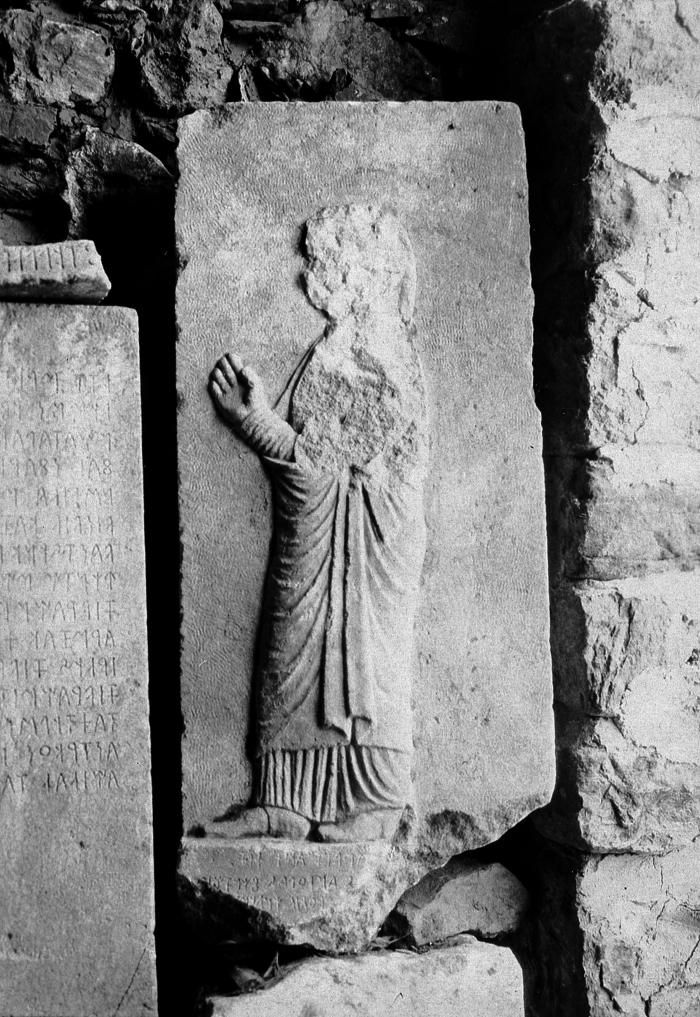 Stele with Praying Woman
R2 Cat. 233
Sculpture
Marble, Stone
450-425 BC (Late Lydian (Persian))
Although there is no sign of dowelling on top, the stele probably had a covering element, possibly a palmette. A female figure facing to I. is placed freely and somewhat asymmetrically on a claw-chiseled background. The sides of the stele are also cl...
-
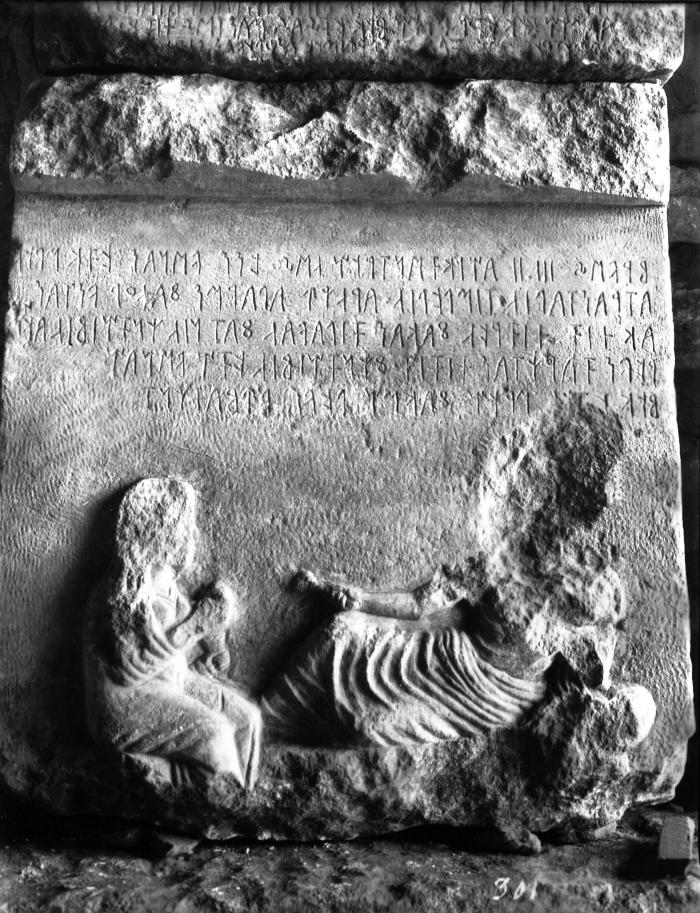 Funerary Stele of Atrastas, son of Timles
R2 Cat. 234
Sculpture
Marble, Stone
330-329 BC (Hellenistic)
C. H. Greenewalt, Jr. noted that at the top, the relief molding has painted egg and dart motif, yellow with black background. There are five lines of text in Lydian, with red preserved in some letters. Below the text is a sculptured scene showing a m...
-
 Relief with Funerary Meal
R2 Cat. 234bis
Sculpture
Marble, Stone
300 BC (Hellenistic)
The bearded man lies on a couch with a drinking cup in his I. hand. A snake coils over his l. shoulder and his veiled wife sits at his feet. Before him stands a three-legged table, beside it a wine jar and a small boy who is serving the wine. On the ...
-
Lion Sejant From Nannas Monument
R2 Cat. 235
Sculpture
Marble, Stone
Ca. 500 BC (Late Lydian (Persian))
The lion is seated in a frontal position. The tail loops under the hindquarters and over the left haunch. The mane has long wavy locks ending slightly down the back, less deeply cut than Synagogue lions (Cat. 25A, Cat. 25B Figs. 92-101). The style is...
-
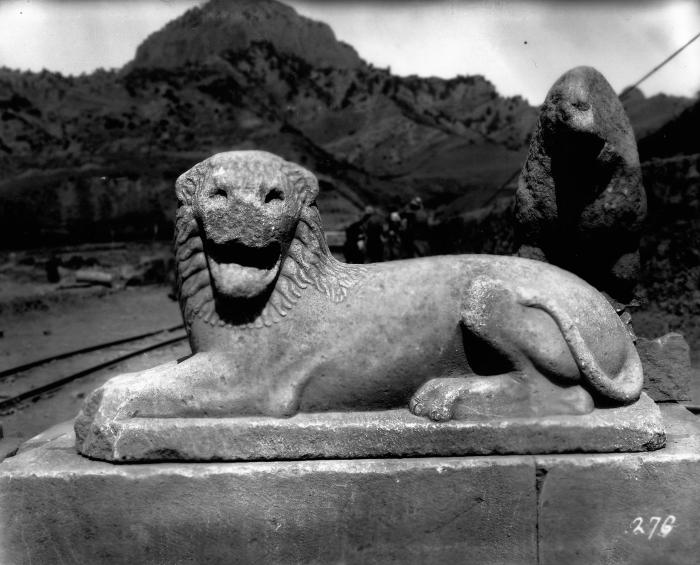 Recumbent Lion From Nannas Monument
R2 Cat. 236
Sculpture
Marble, Stone
550-540 BC (Lydian or Late Lydian)
On a plinth with forepaws extended in front, the lion has its head turned to the l. with the mouth wide open and tongue protruding. The eyes are hollow for inlay, the ears fairly close to the head. The mane is arranged in leaf-like locks, many ending...
-
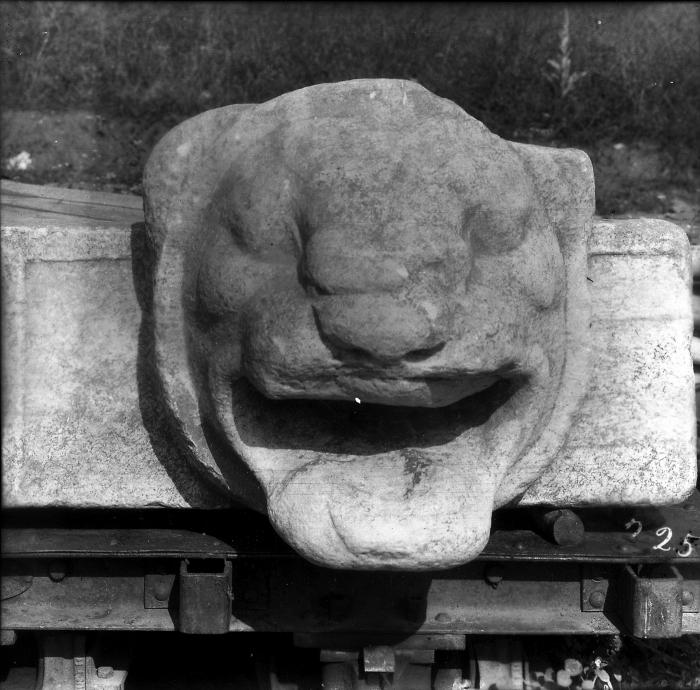 Lion Spout Attached to Rectangular Member
R2 Cat. 237
Sculpture
Marble, Stone
(Lydian?)
"This [colossal lion's head] in all probability belonged to the cornice of the temple and when in place, stood in a position almost directly above the spot where it was found, being the water-spout nearest the corner of the temple. The scale of the h...
-
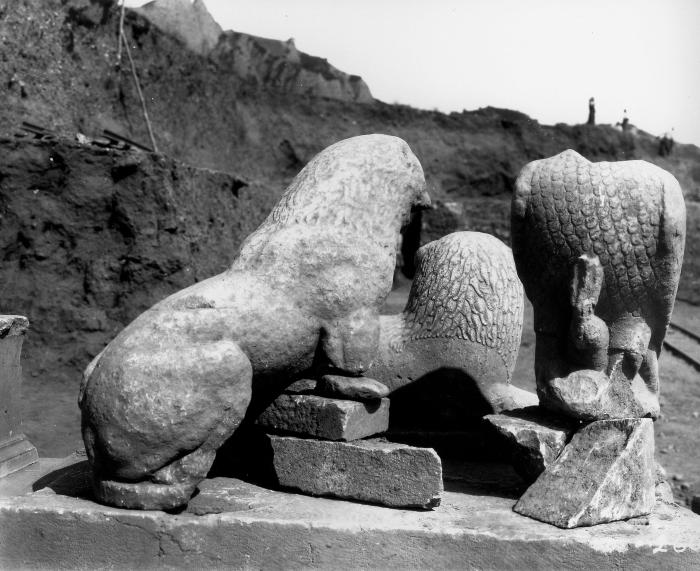 Bird of Prey (Eagle?) Holding a Hare, from the Nannas monument
R2 Cat. 238
Sculpture
Marble, Stone
Late archaic? (Lydian?)
A sitting bird of prey is holding with slightly bent talons a long-eared creature -- hare or rabbit. The wings are folded on the back; they have three tiers of long feathers, while the front part is stylized in small vertical ovals. The chest feather...
-
 Sphinx, presumably part of a throne or seat
R2 Cat. 239
Sculpture
Marble, Stone
480-450 BC (Late Lydian (Persian))
The seated sphinx is partly in the round, partly in relief. A rectangular slab has been worked so that the forelegs and frontal lower part of the body stand free. Behind the head (now lost) and upper part of the body the background was retained and w...
-
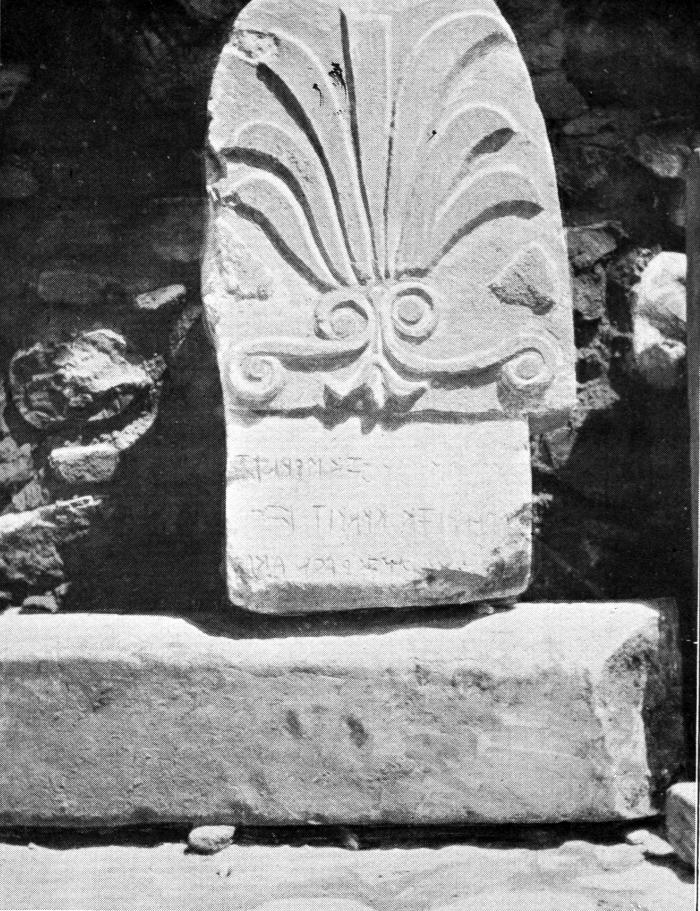 Part of Sepulchral Stele with Palmette
R2 Cat. 240
Sculpture
Marble, Stone
Ca. 420-400 BC (Late Lydian (Persian))
The stele has an oval finial, seven-petalled palmette on antithetic horizontal spirals, and downward-pointed small lotus. The anthemion projects slightly to the spectator's r. "The lateral projection ... was probably next to the dromos, whereas the s...
-
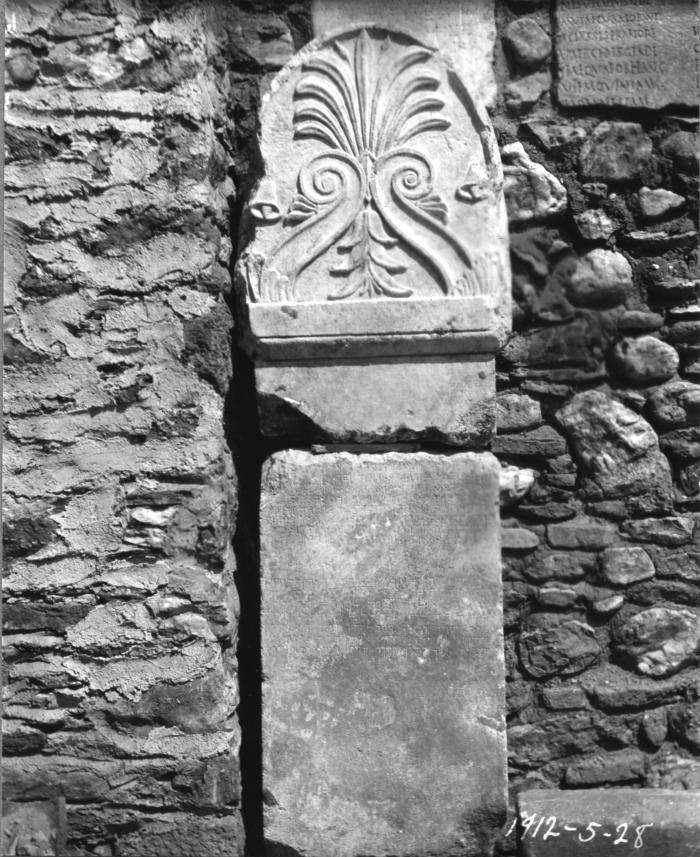 Anthemion with Lydian-Aramaic Bilingual Inscription, Stele of Manes, Son of Kumlis
R2 Cat. 241
Sculpture
Marble, Stone
394 BC (Late Lydian (Persian))
Two vertical half-volutes grow out of small acanthus chalices to support a seven-leaf simple palmette. Two small flowers (or ears of corn?) flank the central petal. Three large downward-pointed chalices are in the center below the palmette. Below the...
-
 Stele of Alikres, Son of Karos
R2 Cat. 242
Sculpture
Marble, Stone
Early 4th C. BC (Late Lydian (Persian))
Funerary stele with Lydian inscription and rounded palmette anthemion, stele of Alikres, son of Karos.
Grayish "local" marble. Much reddish incrustation on face. Piece of marble broken off at top. According to Buckler (Sardis VI, 2, 49) bottom is origi...
-
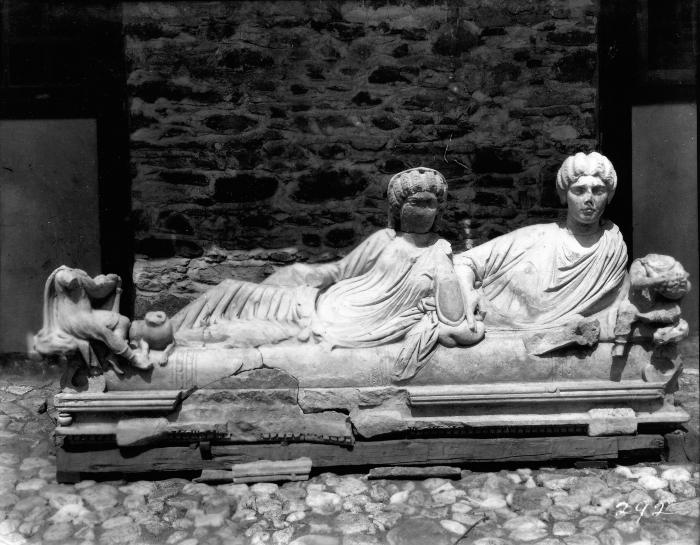 Sarcophagus of Claudia Antonia Sabina
R2 Cat. 243
Sculpture, Sarcophagus
Marble, Stone
2nd or early 3rd C. AD (Roman)
For full description and discussion, see Sardis V, 3ff.; Mansel, Erwerbungsbericht, 176, fig. 6; Ferrari, Commercio Sarcofagi, 39; Lawrence, Additional Sarcophagi, 116ff.; Wiegartz, Säulensarkophage, 158 (Istanbul G) and further bibliography therein....
-
 Sarcophagus Fragment
R2 Cat. 244
Sculpture, Sarcophagus
Marble, Stone
Ca. 170-180 AD (Roman)
The corner fragment comprises "the cornice of the left intercolumniation of a lateral face, and the left extremity of the adjacent raking cornice" (Sardis V, 39). The interior border is raised to hold the lid. The acroteria consist of a headless anim...
-
 Stele of Menophila
R2 Cat. 245
Sculpture
Marble, Stone
2nd or 1st C. BC (Hellenistic)
The pediment has three acroteria: the central one has two snakes pointing downwards; the other two each have one snake pointing upwards. The recessed niche has tapering sides parallel to the stele sides. The relief shows a woman standing in a Pudicit...
-
 Statue of Moschine, Priestess of Artemis
R2 Cat. 246
Sculpture
Marble, Stone
50-25 BC (Hellenistic)
The priestess stands twisted slightly to her l., her r. foot drawn back and resting on the toes. She wears a chiton, himation, and platformed sandals, and stands on a square inscribed base.
The himation is drawn from her r. to her l. side across her b...
-
 Winged Eros
R2 Cat. 247
Sculpture
Marble, Stone
Late 3rd C. BC (Hellenistic)
The nude, winged Eros, just older than a baby, stands with the weight on his r. leg, his head turned slightly to proper l. His r. arm is bent at the elbow and across the body. A small fragment of an arrow is held in his r. hand. The l. hand probably ...