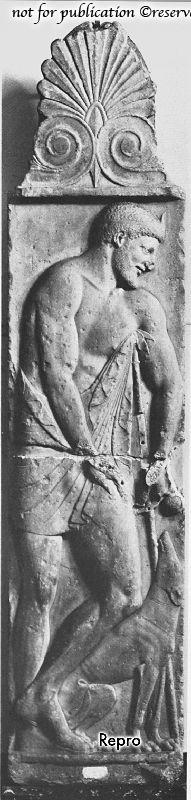
-
 Triple Head of Hekate
R2 Cat. 248
Sculpture
Marble, Stone
Roman? (Roman?)
The central head of the Hekateion has circular locks and a floral crown. The two lateral heads have ribbons in their hair which is parted in the center and falls in long locks on their shoulders. They wear turreted crowns. There are incised lines on ...
-
 Double-Sided Herm with Kouros Figure on One Side and Herm on the Other
R2 Cat. 249
Sculpture
Marble, Stone
1st or 2nd C. AD (Roman)
The kouros, treated as a frontal relief, stands with both feet together and both arms down the sides. A strand of hair remains on his r. shoulder. The neck, chest, and abdomen are outlined in a sharp, linear fashion. The pubic hair is somewhat styliz...
-
 Head of Augustus
R2 Cat. 250
Sculpture
Marble, Stone
1st half of 1st C. AD (Roman)
The idealized head of Augustus is turned slightly to his I. The sharp lines for eyebrows are prominent; the large eyes have no markings for pupil or iris. The nose is sharp and pointed, the mouth small. The face is attractive, but remarkably lacking ...
-
 Head of the Elder Faustina
R2 Cat. 251
Sculpture
Marble, Stone
Ca. 140 AD (Roman)
The following description is after İnan-Rosenbaum: The back of the head is hollow and has a large dowel hole in the center flanked by two oblong dowel holes. Two other dowel holes at ear lobe level are broken away. There are drill channels in the hai...
-
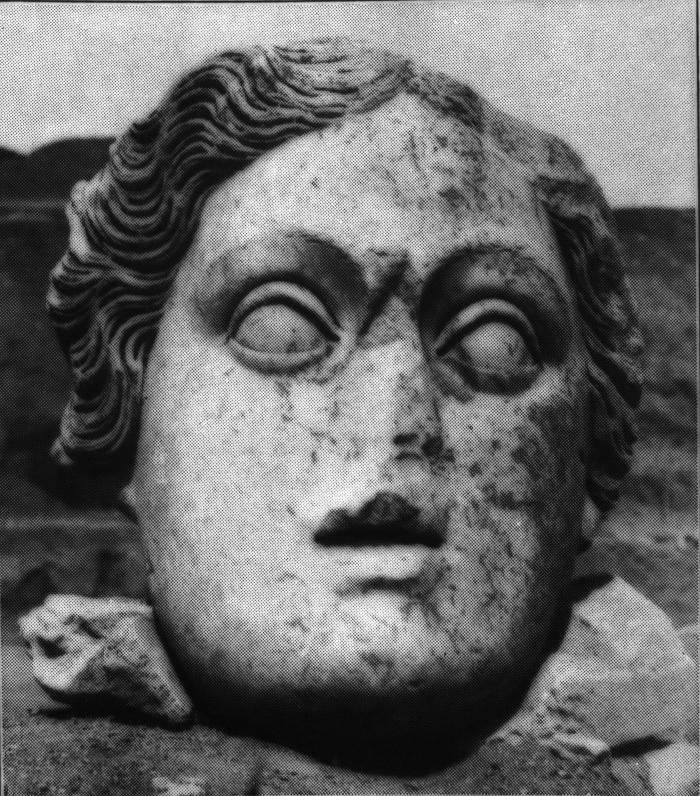 Colossal Female Head, Artemis?
R2 Cat. 252
Sculpture
Marble, Stone
Ca. 140 AD? (Antonine) (Roman)
The following description is taken from Sardis I, 147: "A colossal sculptured face, very well preserved . . . differs entirely from the similar heads found here; for, though in high relief, it was almost certainly never part of an entire head, but wa...
-
 Horseman Riding toward Altar
R2 Cat. 253
Sculpture
Marble, Stone
(Hellenistic)
The horseman, according to Buckler and Robinson, has a crescent behind his shoulders and therefore represents Mên (ibid.). He wears a short belted tunic with a few minimal diagonal folds. In his r. hand he may hold a short stick. The beginning of the...
-
 Head of a Woman
R2 Cat. 254
Sculpture
Marble, Stone
AD 218-235 (Roman)
The portrait was worked for insertion into a statue body. The head is turned slightly to the l., and the woman looks upwards, as indicated by the drilled bean-shaped pupils which are placed high within the incised irises. The surfaces of the eyes are...
-
 Bust of Elpidike
R2 Cat. 255
Sculpture
Marble, Stone
3rd C. AD (Roman)
The bust of a woman is framed by an arched niche with a pilaster on each side, with simple capital and base. The head is turned slightly to the l. Her hair is parted in the middle and drawn behind her ears, where it falls in heavy locks. The drapery,...
-
 Enthroned Mother of the Gods (Cybele)
R2 Cat. 256
Sculpture
Marble, Stone
2nd or 3rd C. AD (Roman)
Cybele is enthroned and seated between two lions. The arched recess in which she sits suggests a shrine. She wears a high-girt chiton with a V-neck. The transparent cloth reveals her navel and the shape of her breasts. A heavier cloth himation is dra...
-
 Lion-Headed Table Leg
R2 Cat. 257
Sculpture
Marble, Stone
2nd or early 3rd C. AD (Roman)
Roaring lion supports a moulded plinth with inscription:
The inscription may refer to erotes or satyrs who carry off jars and food. The piece may have stood against a wall, supporting a shelf.
-
 Head of a Horse
R2 Cat. 258
Sculpture
Marble, Stone
(Hellenistic)
The head, which is turned slightly to the r., has a close-cropped mane which swings to the l. at the top. The horse's ears were erect. His lively face has small eyes beneath heavy bones, large and distended nostrils, and an open mouth with teeth show...
-
 Seated Cybele
R2 Cat. 259
Sculpture
Marble, Stone
Late Hellenistic (Roman)
In plan the statue is a not quite regular rectangle with a projection for the feet. Seen from the back, the lines of the base slant to the l. The goddess sits on the high-backed throne with her legs slightly to proper l. She wears a low polos without...
-
 Lid of Sarcophagus of "Pamphylian" Type
R2 Cat. 260
Sculpture, Sarcophagus
Marble, Stone
Late 2nd C. AD (Roman)
There are very carefully trimmed rectangular bosses (H. 0.10; W. 0.14) at the centers of both ends of the sarcophagus and two on each side. The pediment has a plain epistyle, fine dentils, a Lesbian cyma, and plain band. A gutter decorated with doubl...
-
 Small Recumbent Lion
R2 Cat. 261
Sculpture
Marble, Stone
early 6th C. BC (Lydian)
The archaic smooth-maned, recumbent lion is facing straight ahead. The head is large and round. The flanks and lower legs are nearly straight and vertical. The ruff and low mane are barely rising over the forehead; there is no trace of a back mane. T...
-
 Funerary Stele, Latin
R2 Cat. 262
Sculpture
Marble, Stone
1st C. BC (Hellenistic)
The stele is rectangular with a tenon at the bottom for insertion into another block. Represented on the relief panel are a standing man and woman, three children, and a servant, and in the center background a flat pillar which probably carried an ep...
-
 Hekate
R2 Cat. 263
Sculpture
Marble, Stone
2nd C. AD (Roman)
The three-headed Hekate has a common trunk and polos, and three arms. The faces are badly worn, but are flat, with prominent rounded chins. The hair, parted in the middle, falls in undifferentiated tresses to the shoulders. Breasts are clearly deline...
-
 Stele with Orans
R2 Cat. 264
Sculpture
Marble, Stone
228 AD (Roman)
Set within a slight rectangular depression and standing on a narrow ledge is a standing woman, identified as Trophime in the inscription. In a frontal position, she raises her r. hand in prayer; the l. is at her side. She wears a chiton and a himatio...
-
 Relief with Two Soldiers and Dedication
R2 Cat. 265
Sculpture
Marble, Stone
4th C. AD? (Roman)
In a narrowly recessed rectangular panel stand two soldiers in military dress, their r. hands raised in folds, and they wear a triangular-shaped over-fold with incised parallel V-folds. They also wear boots. The two figures are frontal; there is no e...
-
 Unfinished Herakles
R2 Cat. 266
Sculpture
Marble, Stone
Date unascertainable (Roman)
The unfinished standing frontal male holds his r. arm, bent upwards at the elbow, away from his body. The l. arm is not clear but the vertical, undulating band along the l. side may be a club (therefore, figure thought to be Herakles). The head and h...
-
 Head of Dionysus
R2 Cat. 267
Sculpture
Limestone, Stone
3rd C. AD (Roman)
A horizontal diadem is worn across the top of the forehead. The hair is long and wavy, with ivy and grape bunches, crudely modeled, and with occasional drill holes. At the back the hair is flat. The inner corners of the eyes and pupils are drilled. T...
-
 Draped Female Torso
R2 Cat. 268
Sculpture
Marble, Stone
2nd-3rd C. AD (Roman)
The figure appears to have been moving toward r. with r. arm raised, left lowered and probably held against her stomach, where there is a prominent break. A lock of hair lies on her l. shoulder, falling over the graceful wide neckline of the high-gir...
-
The “Borgia Stele”
R2 Cat. 269
Sculpture
Marble, Stone
Ca. 480-470 BC ()
The controversy over the “Borgia stele” is reviewed with bibliography by Friis-Johansen (Attic Grave-Reliefs, 125, n. 2) who notes that the provenance is not known with certainty. Finati (Supposto Ulisse, 3f., text, pl. 10) states that according to a...
-
 Honorary Stele with Horseman
R2 Cat. 270
Sculpture
Marble, Stone
Late Hellenistic or very early Roman Imperial (Hellenistic or Roman)
A horseman is shown riding to r. and approaching a round altar and tree. He wears a short tunic and a cloak attached with a brooch. His face is too damaged to determine whether or not he was bearded. A snake drinks from a patera (?) on the altar. A w...
-
 Hermes-like Statuette Dedicated to Hosion Kai Dikaion
R2 Cat. 271
Sculpture
Marble, Stone
2nd or 3rd C. AD (Roman)
The figure wears a girt tunic with a chlamys fastened over the r. shoulder and falling down to his feet in back. There is a circular pillar at the l. leg. He holds a caduceus with the lowered l. hand. On the front of the base there is a Greek inscrip...
-
 Marble Block with Inscription in Unknown Language
R2 Cat. 272
Sculpture, Inscription
Marble, Stone
5th-4th C. BC? (Late Lydian (Persian))
"There is no evidence for any covering of the inscription; no remnants of stucco nor mortar revetment backing nor revetment pin holes were observed anywhere on the piers. On the evidence, the inscription was visible when reused" (A.R. Seager, by lett...