-
 Head and Neck of Lion Sejant
R2 Cat. 24
Sculpture
Marble, Stone
6th-5th C. BC (Lydian)
From preserved neck and shoulder it is clear that the lion sat with legs vertical, like the Perachora lion (Boston Museum of Fine Arts no. 97.289, Caskey, Catalogue Boston MFA, 15ff.) or the Metropolitan Sardis lion (Cat. 235 Figs. 405-406), roaring ...
-
 Two Pairs of Addorsed Lions Sejant
R2 Cat. 25A
Sculpture
Marble, Stone
450-350 BC (Late Lydian (Persian))
In the following description, the pair which now bears Manisa museum no. 4031 (S63.037A) will be designated as lions A and B, that with no. 4030 (S63.037B) as C and D. In the view of 4031 which shows the lions’ tails (Fig. 92) lion A is on the left, ...
-
 One of Two Pairs of Addorsed Lions Sejant
R2 Cat. 25B
Sculpture
Marble, Stone
450-350 BC (Late Lydian (Persian))
In the following description, the pair which now bears Manisa museum no. 4031 (S63.037A) will be designated as lions A and B, that with no. 4030 (S63.037B) as C and D. In the view of 4031 which shows the lions’ tails (Fig. 92) lion A is on the left, ...
-
 Lion Couchant
R2 Cat. 26
Sculpture
Marble, Stone
600-570 BC (Lydian)
The recumbent lion lies on a plinth which projects slightly beyond the sides of the animal and is square in front and oval behind. Both pairs of the lion’s feet point forward, and its large flat-topped head is held level. The mouth is open in a roar ...
-
 Rear Half of a Recumbent Lion on Plinth, NW Corner of Altar
R2 Cat. 27
Sculpture
Sandstone, Stone
Ca. 570-560 BC (Lydian)
The two and one half recumbent lions (Cat. 27, Cat. 28, Cat. 29 Figs. 105-117) are from the altar of Kuvava (H. 1.73; L. 3.10; W. 2.05) in the sector PN. They are of very crumbly sandstone. A sample of Cat. 28 (taken Aug. 14, 1975) was determined at ...
-
 Recumbent Lion on Plinth, South-East Corner of Altar
R2 Cat. 28
Sculpture
Sandstone, Stone
570-560 BC (Lydian)
The two and one half recumbent lions which follow (Cat. 27, Cat. 28, Cat. 29 Figs. 105-117) are from the altar of Kuvava (H. 1.73; L. 3.10; W. 2.05) in the sector PN. They are of very crumbly sandstone. A sample of Cat. 28 (taken Aug. 14, 1975) was d...
-
 Recumbent Lion on Plinth, South-West Corner of Altar
R2 Cat. 29
Sculpture
Sandstone, Stone
570-560 BC (Lydian)
The two and one half recumbent lions which follow (Cat. 27, Cat. 28, Cat. 29 Figs. 105-117) are from the altar of Kuvava (H. 1.73; L. 3.10; W. 2.05) in the sector PN. They are of very crumbly sandstone. A sample of Cat. 28 (taken Aug. 14, 1975) was d...
-
 Hindquarters of Small Archaic Recumbent Lion
R2 Cat. 30
Sculpture
Marble, Stone
560-550 BC (Lydian)
The lion lies on a shallow plinth which follows his shape. The tail comes up over the rump and curls in, tucked between the r. knee and body, then blends into the rump at back. The feet are carefully worked, showing the claws. The back and legs are w...
-
 Large Recumbent Lion
R2 Cat. 31
Sculpture
Marble, Stone
Ca. 560-550 (Lydian)
The recumbent archaic lion on a plinth has a tail starting as a faint “fat sheep” rise with dividing pattern. It is slung up over the l. hind leg. The head faces forward with mouth open and tongue lying flat. Deeply grooved whiskers are delineated by...
-
 Fragment of Colossal Lion’s Foot
R2 Cat. 32
Sculpture
Marble, Stone
Ca. 560-550 BC (Lydian)
The leg and paw from a reclining lion are extended flat on the worked surface of a base. There are large flat chisel strokes on the leg, which is finished with multiple chisel cross strokes. The exterior of the base shows large point and gouge. Acco...
-
 Lion’s Right Foot on Plinth
R2 Cat. 33
Sculpture
Marble, Stone
Ca. 550 BC? (Lydian)
The front of the plinth is flat. The surface is covered with claw chisel marks. The leg and paw appear to be lying flat on the surface of the plinth and are, therefore, from a reclining lion. The workmanship is all flat chisel on the claws and base. ...
-
 Lioness
R2 Cat. 34
Sculpture
Marble, Stone
550-530 BC (Late Lydian (Persian))
The recumbent lioness is roaring. A collar mane frames her face below the ears. The very linear, triangular, incised locks are lancet-like on the mane, leaf-like on the chest. The tail is slung over the r. hindquarter. Large hind paws with toes are i...
-
 Marble Sculpture of a Recumbent Lion
R2 Cat. 35
Sculpture
Marble, Stone
Ca. 540 BC (Late Lydian (Persian))
The outline of the lion's foreleg is linear as is the rendering of the hair, with incised laurel-leaf-shaped locks for the chest mane. The tail goes under and around the l. haunch, as in Cat. 31 (Fig. 119). There is a fold of flesh at the hock of the...
-
 Acroterion (?), Small Recumbent Lion from Corner of Archaic Sarcophagus Lid
R2 Cat. 36
Sculpture, Sarcophagus
Marble, Stone
Ca. 500 BC? (Late Lydian (Persian)?)
In the break of the r. side of the lion there is seen an oblique surface which rises markedly to the proper r. The lion lies on a "base." It has a fat, massive chest and shoulders, short hind legs, with incised claws on the l. hind leg. The l. should...
-
 Lion’s Paw
R2 Cat. 37
Sculpture
Marble, Stone
Late 6th or 5th C. BC (Lydian)
The piece has an interesting stylization of the upper parts of the lion’s claws as a flat band and a similarly ornamental flat band at the back of the leg. The paw is well modeled with high rounded forms of toes. No rough drill was used. It is not a ...
-
 Marble Sculpture of a Walking Lion
R2 Cat. 38
Sculpture
Marble, Stone
Ca. 350-330 BC (Late Lydian (Persian))
The large rounded muscles of the shoulders, body, and hind legs are shown in motion. The mane had a halo-like arrangement radiating around the face, then descending in a triangle over the chest. Upright head and entire chest were turned to his r. A b...
-
 Part of Frame with Walking Lion
R2 Cat. 39
Sculpture
Marble, Stone
Ca. 400 BC (Late Lydian (Persian))
The fragment has a thin, fine low relief of a lion walking to the r. on a thin, straight ground line. The relief comes from a horizontal band-like part which was the top section of a rather small frame. A bit of projection on the smooth underside ind...
-
 Lower Part of Archaic Siren
R2 Cat. 40
Sculpture
Marble, Stone
530-500 BC (Late Lydian (Persian))
Going all around from sex to tail are rows of downward-pointed feathers stylized in leaf-like shapes. Each leaf is oval with median rib. Two vertical rows fill out the triangle between the side feathers and tail on the proper l. They are somewhat bet...
-
 Marble Sculpture of a Headless Recumbent Sphinx
R2 Cat. 41
Sculpture
Marble, Stone
Late 6th or 5th C. BC? (Late Lydian (Persian))
A straight rectangular cut was made to seat the neck, head, and part of the wing (rectangle: W. 0.19, L. 0.15; dowel hole: diam. 0.035, D. 0.035). Judging from the cutting, the head may have been slightly turned to the proper r. The tail is slung up ...
-
 Sphinx, Probably from a Throne
R2 Cat. 42
Sculpture
Marble, Stone
4th or 3rd C. BC? (Late Lydian (Persian)?)
Unlike Cat. 41 (Figs. 142-143), this sphinx is made in one piece with the lower back part of the throne. The body is partly in the round (at the front and on top) and partly in relief and, unlike Cat. 41, the relief background extends under the body ...
-
 Relief Fragment of Frog and Support
R2 Cat. 43
Sculpture
Marble, Stone
(Lydian?)
The soft and simple treatment of the frog’s body is very effective. This simplicity (from above the frog looks like an archaic lion) and the very straight line down the spine suggest an archaic monument. The channel might indicate that the piece was ...
-
 Relief Fragment with Rearing Animal
R2 Cat. 44
Sculpture
Marble, Stone
5th-4th C. BC? (Late Lydian (Persian)?)
The thick relief block shows an animal charging or rearing to the l. Only the body remains; most of the neck, legs, and tail are broken off. Perhaps the tail curved over the back since there is a trace of the end in the appropriate position. Accordin...
-
 Fragment of Anthemion
R2 Cat. 46
Sculpture
Marble, Stone
530-520 BC (Late Lydian (Persian))
Fragment of a stele with lotus-volute finial (anthemion).The general type is made clear by the stele Cat. 45 (Figs. 148-149; and a closely comparable fragment from Daskylion (Fig. 152). Preserved is the central part of the finial and the broad raised...
-
 Chamber Tomb Stele
R2 Cat. 47
Sculpture
Limestone, Stone
520-480 BC (Late Lydian (Persian))
The plain shaft rises from a simple low rectangular base. The proportion of shaft H. to W. is 4:1. Unlike Cat. 45 and Cat. 46 (Figs. 148-151) the convex volutes rose from two central stems; the eye was an elaborate plastic rosette. A thin, "mannerist...
-
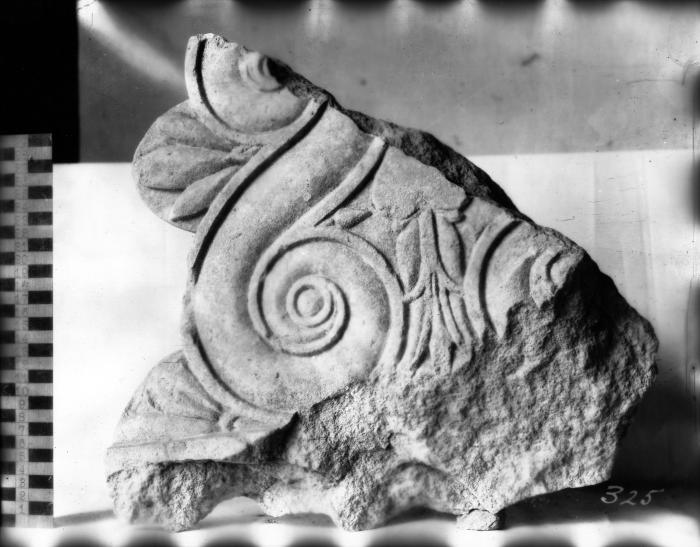 Fragment of Anthemion
R2 Cat. 48
Sculpture
Marble, Stone
500-450 BC (Late Lydian (Persian))
The finial consisted of two spirals symmetrically placed in lyre-like design. H.C. Butler writes, "The two double reversed scrolls carried some crowning feature like a palmette. The scrolls were described by pulvinated bands with raised flat edges. T...