About search...

This area allows you to search for and learn about artifacts published by the Sardis Expedition. Currently (2020) the database consists of artifacts in the exhibition and catalog “The Lydians and Their World” (Yapı Kredi Vedat Nedim Tör Museum, Istanbul, 2010); Judith Schaeffer, Nancy Hirschland Ramage, and Crawford H. Greenewalt, jr., Sardis M10: Corinthian, Attic, and Lakonian Pottery; Jane Evans, Sardis M13: Coins from the Excavations at Sardis: Their Archaeological and Economic Contexts; Georg Petzl, Sardis M14: Greek and Latin Inscriptions, Part II: Finds from 1958 to 2017; G.M.A. Hanfmann ve N.H. Ramage, Sardis R2: Sculpture from Sardis: The Finds through 1975; and A. Ramage, N.H. Ramage, ve Gül Gürtekin-Demir, Sardis R8: Ordinary Lydians at Home: The Lydian Trenches of the House of Bronzes and Pactolus Cliff at Sardis. In coming years we intend to add objects from other Sardis Reports and Monographs.

Clear All

Select an object type from the list below. Certain object types (including architectural terracottas, coins, pottery, sculpture) include subtypes (shape and ware of pottery, denomination and mint of coins) to refine your search.

Refine Coin

Refine Inscription

Select the language of inscribed texts from the list below.

Refine Metalwork

Refine Pottery

Refine Sculpture

Refine Architectural Terracotta

Select a material from the list below.

Select a museum from the list below.

Select a Sardis CATNUM from the list below. CATNUM is made up from object type, year, and sequential number. BI = Bone Implement; G = Glass; J = Jewelry; L = Lamp; M = Metal; NoEx = not excavated; Org = Organic; P = Pottery; S = Sculpture. Coins are numbered with the year of discovery and a running number, or year, C, and a running number. Currently (Feb. 2020) this doesn't give a complete list, only the first 99 entries; to find a specific CATNUM, please use the full-text search at the top of the page.

Select a historical period from the (alphabetical) list below. Note that periods are defined culturally rather than politically, so Lydian (rather than Archaic) refers to the period ca. 800 BC - ca. 547 BC; Late Lydian or Persian (rather than Late Archaic or Classical) from ca. 547 until ca. 330 BC; Hellenistic until the earthquake of 17 AD; Roman and Late Roman continue until the early 7th century AD, except for coins where, as traditional, Prof. Evans begins the Byzantine period in the 6th century.

Select a publication name from the list below. LATW = Lydians and Their World (2010). R2 = Hanfmann and Ramage, Sculpture from Sardis (1978). R8 = A. Ramage, N.H. Ramage, ve Gül Gürtekin-Demir, Sardis R8: Ordinary Lydians at Home: The Lydian Trenches of the House of Bronzes and Pactolus Cliff at Sardis (2021). M10 = Schaeffer, Ramage, and Greenewalt, The Corinthian, Attic, and Pottery from Sardis (1997). M13 = Evans, Coins from the Excavations at Sardis, 1973-2013 (2018). M14 = Petzl, Sardis: Greek and Latin Inscriptions, Part II (2019).

Select a site from the list below.

The stratigraphic contexts (findspots) of artifacts from Sardis are recorded at different levels of specificity. Sector is the most general, referring to a broad area of the city. Trenches are yearly excavation areas (in current usage) or more specific areas of sectors (in early records which used a different excavation system). A Locus is a single stratigraphic unit, i.e. a single deposit of soil, a destruction level, a grave, a dump or other deposit. For instance, MMS-I 84.1 Locus 34 is the destruction level from one room of a Lydian house just inside the fortification wall in sector MMS, containing a rich deposit of Lydian pottery and other artifacts. Note that loci can be continued over a number of years, and so belong to different trenches, if the same stratigraphic unit is excavated over a number of years. For a list of sectors see Hanfmann and Waldbaum, A Survey of Sardis and the Major Monuments Outside the City Walls (Sardis R1, 1975), 13-16. Currently (2020) in order to search for a specific locus, you must search for Trench first to narrow the results, and then search within that for the locus. Sorry.

The stratigraphic contexts (findspots) of artifacts from Sardis are recorded at different levels of specificity. Sector is the most general, referring to a broad area of the city. Trenches are yearly excavation areas (in current usage) or more specific areas of sectors (in early records which used a different excavation system). A Locus is a single stratigraphic unit, i.e. a single deposit of soil, a destruction level, a grave, a dump or other deposit. For instance, MMS-I 84.1 Locus 34 is the destruction level from one room of a Lydian house just inside the fortification wall in sector MMS, containing a rich deposit of Lydian pottery and other artifacts. Note that loci can be continued over a number of years, and so belong to different trenches, if the same stratigraphic unit is excavated over a number of years. For a list of sectors see Hanfmann and Waldbaum, A Survey of Sardis and the Major Monuments Outside the City Walls (Sardis R1, 1975), 13-16. Currently (2020) in order to search for a specific locus, you must search for Trench first to narrow the results, and then search within that for the locus. Sorry.

The stratigraphic contexts (findspots) of artifacts from Sardis are recorded at different levels of specificity. Sector is the most general, referring to a broad area of the city. Trenches are yearly excavation areas (in current usage) or more specific areas of sectors (in early records which used a different excavation system). A Locus is a single stratigraphic unit, i.e. a single deposit of soil, a destruction level, a grave, a dump or other deposit. For instance, MMS-I 84.1 Locus 34 is the destruction level from one room of a Lydian house just inside the fortification wall in sector MMS, containing a rich deposit of Lydian pottery and other artifacts. Note that loci can be continued over a number of years, and so belong to different trenches, if the same stratigraphic unit is excavated over a number of years. For a list of sectors see Hanfmann and Waldbaum, A Survey of Sardis and the Major Monuments Outside the City Walls (Sardis R1, 1975), 13-16. Currently (2020) in order to search for a specific locus, you must search for Trench first to narrow the results, and then search within that for the locus. Sorry.

Showing 942 results for:   Lydian
  • Attic Black Figure Band Skyphos Fragment
    Attic Black Figure Band Skyphos Fragment

    M10 Cat. Att 86

    Pottery

    Ceramic

    Ca. 550 BC (Lydian)

    Two joining fragments. Above band, the palmette and tendril from near the handle, and next to it, the wing, tail, feet, and part of the body of a siren. Added purple on the heart of the palmette, on the tail feathers, and for tiny dots on the belly. ...

  • Attic Black Figure Plate Fragment
    Attic Black Figure Plate Fragment

    M10 Cat. Att 88

    Pottery

    Ceramic

    575-550 BC (Lydian)

    Fragment. Interior: central tondo and surrounding frieze. In tondo, part of a floral cross is preserved with the end of a curling tendril. A series of four concentric lines separates the tondo from frieze, on which are preserved the forelegs and fore...

  • Lower Portion of an Attic Black Glaze Amphoriskos
    Lower Portion of an Attic Black Glaze Amphoriskos

    M10 Cat. Att 158

    Pottery

    Ceramic

    575-550 BC (Lydian)

    Foot and lower body. Conical foot with a small cone on the underside. Reserved: outer face of the foot, underside of the foot and cone. Glaze is streaky in one area.

    Probably among the earliest Athenian black-glaze pieces to arrive at Sardis. Although...

  • Attic Black Glaze Band Cup Fragment
    Attic Black Glaze Band Cup Fragment

    M10 Cat. Att 178

    Pottery, Graffito

    Ceramic

    Ca. 550 BC (Lydian)

    Fragment of body. Lydian graffito incised in band ]ursisbil [, translated by R. Gusmani as "X, (son) of Y, the (priest?), dedicated (?) . . . ." Its Attic manufacture has been confirmed by chemical analysis (Appendix 2, sample AP 18b).

  • Attic Black Glaze Miniature Kothon Fragment
    Attic Black Glaze Miniature Kothon Fragment

    M10 Cat. Att 585

    Pottery

    Ceramic

    600-550 BC (Lydian)

    Fragment of body. Reserved except for a wide band on the lower part of the body, and dots between thick lines on the upper part of the body. Possibly one of the earliest pieces of Attic black glaze to arrive at Sardis.

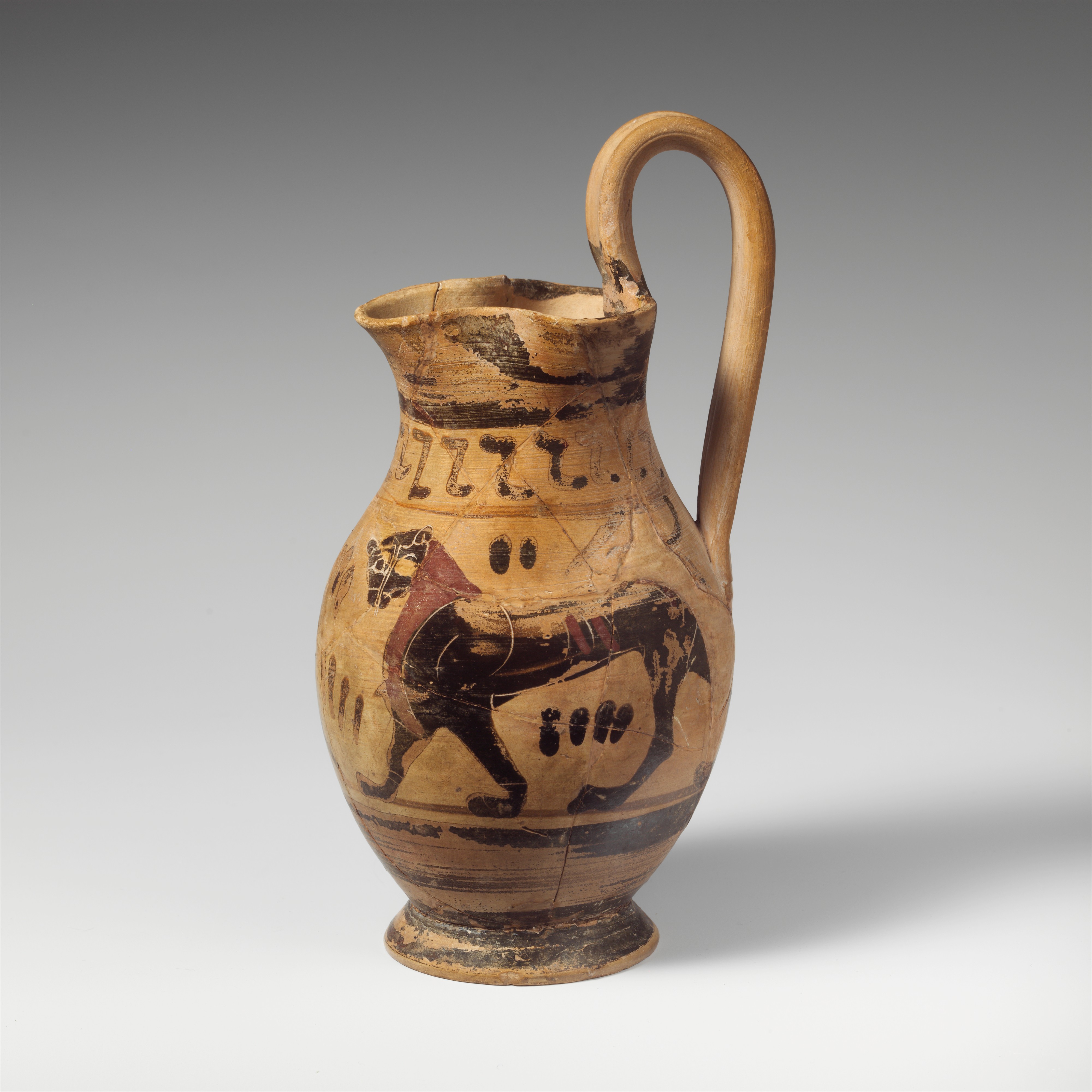
  • Attic Black Figure Olpe
    Attic Black Figure Olpe

    M10 Cat. Att App. 5

    Pottery

    Ceramic

    Ca. 560-540 BC (Lydian)

    Restored from many fragments; complete except for small pieces of the rim and body. Two panthers, walking on a ground line are confronted at either side of a stylized lotus flower. Their heads face front. The tail of each curls up and "disappears" be...

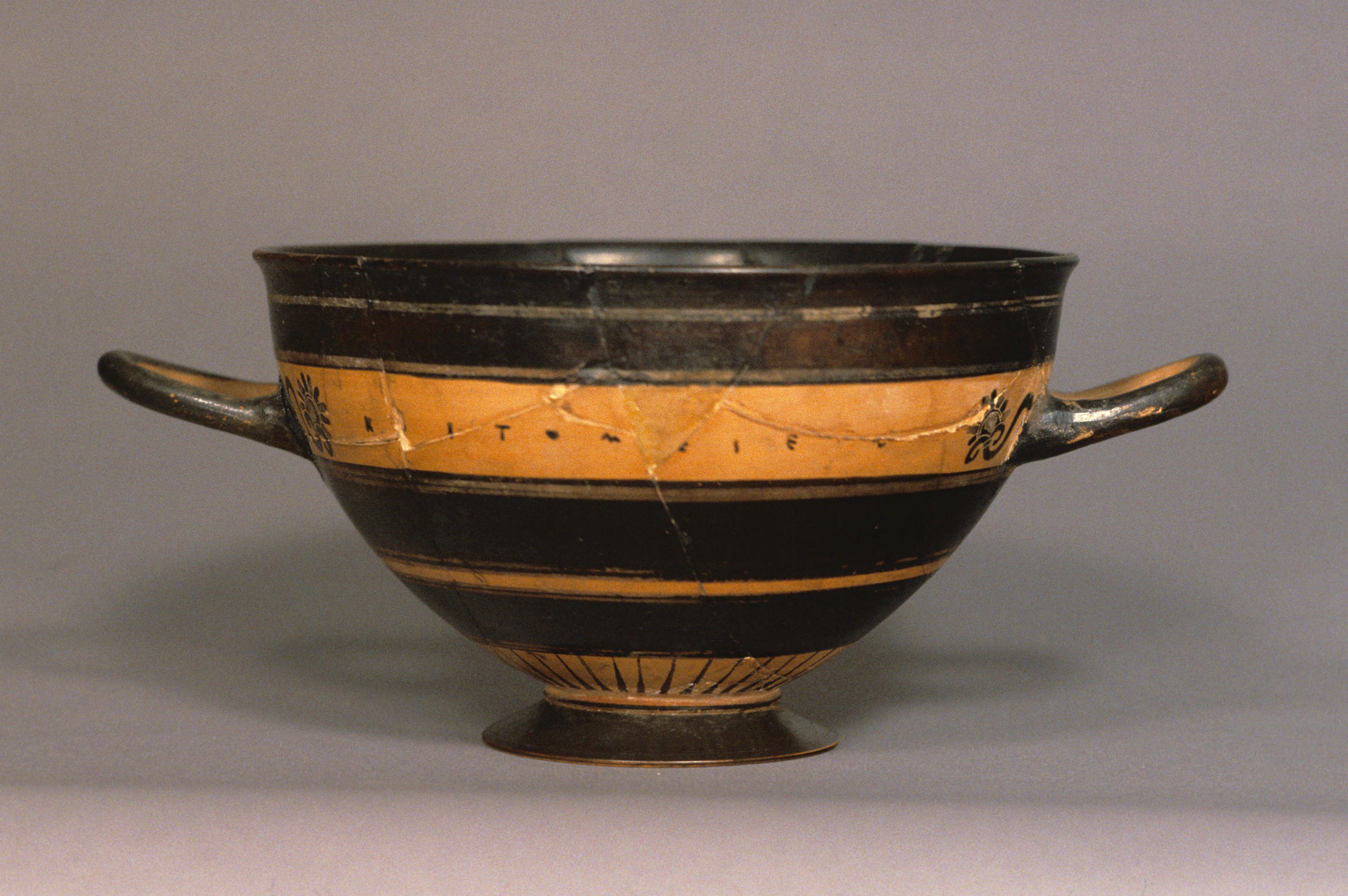
  • Attic Black Figure Skyphos
    Attic Black Figure Skyphos

    M10 Cat. Att App. 15

    Pottery

    Ceramic

    Ca. 550 BC (Lydian)

    Complete except for a few small parts of the bowl and rim. Repaired from many fragments. Exterior: the handle zone, a narrow band at the midpoint between the handle zone and the base, and a zone at base on which rays are painted are all reserved. Abo...

  • Lakonian II Cup Fragments
    Lakonian II Cup Fragments

    M10 Cat. Lak 1

    Pottery

    Ceramic

    Ca. 600 BC (?) (Lydian)

    Six non-joining fragments of rim and bowl, one with swelling of handle base. Clay soft, somewhat flaky, light brown, non-micaceous.

    Interior: black (5 Y 3/1--2.5/1) glaze, over which thin white bands, two in the bowl, one at the base of the lip.

    Exteri...

  • Lakonian II Cup Fragment
    Lakonian II Cup Fragment

    M10 Cat. Lak 2

    Pottery

    Ceramic

    Ca. 600 BC (?) (Lydian)

    Fragment of shoulder and bowl, with handle stump. Delicate construction. Clay hard, fine, tan, non-micaceous. Interior and exterior, light yellow cream (10 YR 7/3) slip, over which decoration in black (dark sepia, 10 YR 2/1) glaze and red (10 R 4/3) ...

  • Lakonian II Cup Fragment
    Lakonian II Cup Fragment

    M10 Cat. Lak 3

    Pottery

    Ceramic

    Ca. 600 BC (Lydian)

    Small rim fragment. Delicate construction. Clay pink tan (5 YR 7/6--6/6). Decoration in cream (10 YR 8/4) slip, black (N2/) glaze. Interior: black glaze, over which narrow cream band near top.

    Exterior: cream slip, over which black ladder-and-dot pat...

  • Lakonian II Cup Fragment
    Lakonian II Cup Fragment

    M10 Cat. Lak 4

    Pottery

    Ceramic

    Ca. 600 BC (Lydian)

    Handle zone-lower body fragment. Clay light brown (7.5 Y R 6/4) with little or no mica.

    Interior: streaky dark brown/black (5YR 2/2) glaze with metallic sheen.

    Exterior: cream (2.5 Y R 8/4) slip, over which decoration in brown (10 Y R 5/6) glaze and r...

  • Lakonian Black-figure Cup Fragments
    Lakonian Black-figure Cup Fragments

    M10 Cat. Lak 5

    Pottery

    Ceramic

    Ca. 560-555 BC (Lydian)

    Two fragments from outer part of bowl. Clay micaceous, light brown (7.5 YR 6/6). Interior and exterior, cream slip, over which decoration in black glaze and red paint (the latter over glaze and only on B). Incision on interior.

    Interior of A: knees an...