-
 Başsız Yaslanmış Sfenksin Mermer Heykeli
R2 Cat. 41
Heykel
Mermer, Taş
Late 6th or 5th C. BC? (Geç Lidya (Pers))
A straight rectangular cut was made to seat the neck, head, and part of the wing (rectangle: W. 0.19, L. 0.15; dowel hole: diam. 0.035, D. 0.035). Judging from the cutting, the head may have been slightly turned to the proper r. The tail is slung up ...
-
 Muhtemelen Tahttan Sfenks
R2 Cat. 42
Heykel
Mermer, Taş
4th or 3rd C. BC? (Geç Lidya (Pers)?)
Unlike Cat. 41 (Figs. 142-143), this sphinx is made in one piece with the lower back part of the throne. The body is partly in the round (at the front and on top) and partly in relief and, unlike Cat. 41, the relief background extends under the body ...
-
 Kurbağa ve Destek Kabartma Parçası
R2 Cat. 43
Heykel
Mermer, Taş
(Lidya?)
The soft and simple treatment of the frog’s body is very effective. This simplicity (from above the frog looks like an archaic lion) and the very straight line down the spine suggest an archaic monument. The channel might indicate that the piece was ...
-
 Yetiştirme Hayvanı ile Rölyef Parçası
R2 Cat. 44
Heykel
Mermer, Taş
5th-4th C. BC? (Geç Lidya (Pers)?)
The thick relief block shows an animal charging or rearing to the l. Only the body remains; most of the neck, legs, and tail are broken off. Perhaps the tail curved over the back since there is a trace of the end in the appropriate position. Accordin...
-
 Anthemion Parçası
R2 Cat. 46
Heykel
Mermer, Taş
530-520 BC (Geç Lidya (Pers))
Fragment of a stele with lotus-volute finial (anthemion).The general type is made clear by the stele Cat. 45 (Figs. 148-149; and a closely comparable fragment from Daskylion (Fig. 152). Preserved is the central part of the finial and the broad raised...
-
 Oda Mezarı Stel
R2 Cat. 47
Heykel
Kireçtaşı, Taş
520-480 BC (Geç Lidya (Pers))
The plain shaft rises from a simple low rectangular base. The proportion of shaft H. to W. is 4:1. Unlike Cat. 45 and Cat. 46 (Figs. 148-151) the convex volutes rose from two central stems; the eye was an elaborate plastic rosette. A thin, "mannerist...
-
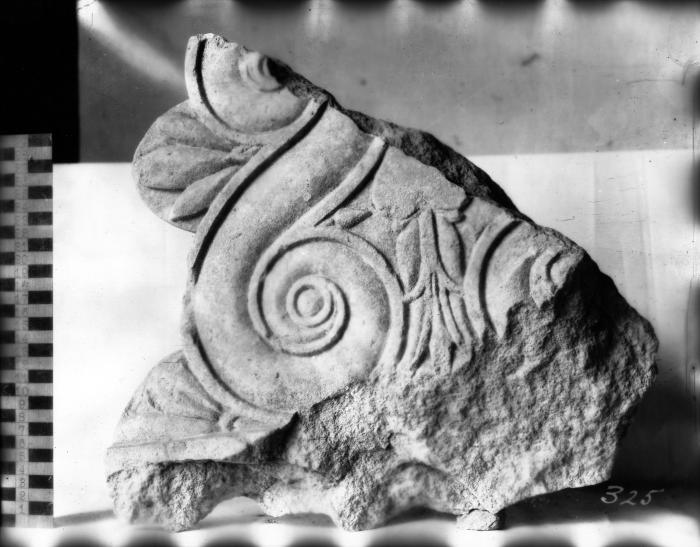 Marşın Parçası
R2 Cat. 48
Heykel
Mermer, Taş
500-450 BC (Geç Lidya (Pers))
The finial consisted of two spirals symmetrically placed in lyre-like design. H.C. Butler writes, "The two double reversed scrolls carried some crowning feature like a palmette. The scrolls were described by pulvinated bands with raised flat edges. T...
-
 Lidce Yazıtlı Anthemion Stel Parçası
R2 Cat. 49
Heykel
Mermer, Taş
Later 5th or 4th C. BC? (Geç Lidya (Pers)?)
The carefully cut ornament includes part of a downward-pointed lotus with five thin leaves, a concave leaf-like ending to the lower part of a volute, and a rounded part above. The finial projected sideways from the shaft. The leaf-like volute end con...
-
 Dekorlu Mermer Parçası
R2 Cat. 50
Heykel
Mermer, Taş
6th C. BC? (Lidya?)
The slab, probably a door lintel rather than a doorjamb, must come from a chamber tomb in the mound. It is decorated on one side with two connected spirals incised within a panel with raised edges. K. J. Frazer observed that the rougher areas outside...
-
 Sima Frizinin Parçası?
R2 Cat. 51
Heykel
Mermer, Taş
520-500 BC (Geç Lidya (Pers))
The tall relief is crisply cut and smoothed. Part of the lotus and the tip of a palmette are at the top l. The central leaf rises to a sharp median ridge, the l. leaf to a less marked one. Found in the top layer of LA 2, the late archaic piece may be...
-
 Lotus ve Volute Palmette ile Fragment
R2 Cat. 52
Heykel
Mermer, Taş
520-500 BC (Geç Lidya (Pers))
The fragment has part of a double lotus with five (?) leaves arching over a large seven-petalled palmette between two Ionic volutes (only the l. preserved). A smaller downward-pointed palmette has five petals. The floral decoration is on a straight f...
-
 Yüksek Giritli Chitonlu Torso Parçası
R2 Cat. 53
Heykel
Mermer, Taş
(Hellenistik)
The lady wears a high-girt chiton, tied beneath the breasts with a ribbon belt ending in a double knot. The diagonal folds of the bound-up cloth of the himation are slung across her hips. The banded border at the neckline of the chiton comes to a sli...